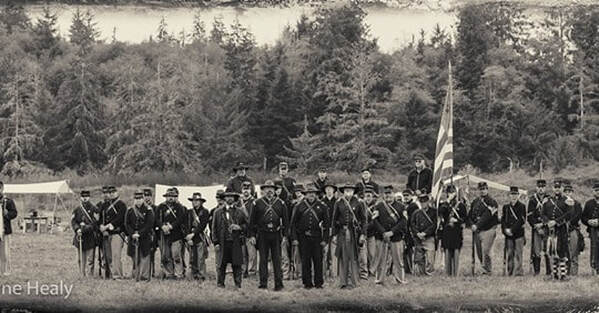
Union Battalion Staff
UNION BATTALION COMMANDER:
John Leaton [email protected] 541-852-9806
EXECUTIVE OFFICER: Steve Stowell
ADJUTANT: Matt Cleman
Wing Commander: Ben Sanford [email protected]
SERGEANT MAJOR: Jon Hile
CHAPLAIN: Donny Cameron [email protected]
Chief Musician:
FACEBOOK:
Northwest Civil War Council
(We have a private one for members, and an informational one for the general public to follow along.) See "Reenactor Information" under the "Events" tab.
John Leaton [email protected] 541-852-9806
EXECUTIVE OFFICER: Steve Stowell
ADJUTANT: Matt Cleman
Wing Commander: Ben Sanford [email protected]
SERGEANT MAJOR: Jon Hile
CHAPLAIN: Donny Cameron [email protected]
Chief Musician:
FACEBOOK:
Northwest Civil War Council
(We have a private one for members, and an informational one for the general public to follow along.) See "Reenactor Information" under the "Events" tab.
Military Unit Contacts and Related Websites
1st MINNESOTA VOLUNTEER INFANTRY
Ashley Wendel [email protected] 541.852.1246
The year was 1861, and the first shots were fired on Fort Sumpter. Governor Ramsey was in Washington, DC, at the time, and immediately pledged 1,000 troops for service. They were the first troops to be pledged as a volunteer regiment for the American Civil War, and they would continue to serve honorably until the end of the war. Just two weeks later, the 1st Minnesota Regiment was mustered at Fort Snelling on April 29, 1861. They served in the Army of the Potomac, being one of the most western units to actively fight on the eastern front. At Gettysburg in July of 1863, they held the line, losing 215 out of 262 of their men.
26th New York Colored Regiment (USCT)
Jerry Parkman [email protected] 360-947-5610
www.facebook.com/groups/450843316048600
The 26th United States Colored Infantry was organized from February through March 1864 at Rikers Island, New York. The regiment was ordered to Johns and James Island, South Carolina, in July 1864, and was ordered to assault Battery Pringle on July 7th. On November 30, 1864, the 26th USCT provided support at the Battle of Honey Hill. The regiment was stationed at Fort Duane, South Carolina, from August 1864 until May 1865, and was mustered out in 1865. Approximately 200,000 African-Americans served in the United States Colored Troops during the Civil War.
69th NEW YORK, Co. K INFANTRY
Matt Gibson [email protected] 503.753.6586
www.69thnyoregon.org
The 69th New York Infantry Regiment was organized in New York City between September and November 1861 as part of Meagher’s Irish Brigade and mustered into United States service for three years. The regiment included many members of the pre-war 69th New York State Militia and companies recruited in New York and other cities, with Company K principally formed in Buffalo. After leaving the state in November 1861, it served at Fort Corcoran, near Washington, D.C., before joining the Army of the Potomac, where it participated in major campaigns on the Virginia Peninsula and in Maryland and Pennsylvania. The unit fought in numerous battles, including Fair Oaks, Antietam, Fredericksburg, Gettysburg, and the Petersburg and Appomattox campaigns, suffering heavy casualties throughout the war. It was honorably mustered out near Alexandria, Virginia, on June 30, 1865, having earned distinction within the Irish Brigade for its sustained service.
79th NEW YORK HIGHLANDERS INFANTRY
Samuel Stillwell [email protected] 503.807.2052
Cameron Highlanders of the Northwest
The 79th was formed prior to the opening of the civil war in 1858-1859 as a militia or Highland guard, composed mostly of first and second generation Scottish immigrants through the Caledonian club of New York. When the civil war broke out, the 79th answered the call. Through the war the regiment maintained its Scottish identity and participated in nearly every major engagement and campaign with very few exceptions. notably the 79th was at 1st Bull Run, Secessionville, Chantilly, Antietam, Vicksburg, Ft. Sanders and the Wilderness to name a few. When their enlistments were up in1864 they departed the battlefield and a portion of the regiment reformed in New York as the 79th veteran volunteers where they saw action till the end of the war. The 79th had seen 27 battles in their years of service; they were a hard fighting regiment and were one of the most well traveled units during the war.